What's Wrong from Paul William Craddock on Vimeo.
Showing posts with label what's wrong. Show all posts
Showing posts with label what's wrong. Show all posts
Wednesday, 4 March 2020

Tuesday, 4 February 2020
What's Wrong

What do we mean by 'wrong'? Creative people, craftspeople, curators and conservators all have a particular understanding of wrongness. They also have a language to express it which is both enlightening and useful.
I had noticed though that to extract this language it was necessary for them all to have their tools or materials in hand before you got to the really interesting stuff. After several good chats with surgeons I realised that the same was true of them. This led me to thinking about what would happen if I got them together with those mentioned above and see what would happen. Would they agree? Would they speak the same language or would their criteria be too different?

On November 15th 2019 I did just this. It wasn't the first time that some of them had met but now I wanted to really get deep into their expertise. I wanted to know how they judged wrongness; was it context? was it colour based? was it a combination of their senses....a mix of sight and touch? I wanted their 'word hoards'. I wanted to see if we could share this language with others both to express why creativity is important to all and to help others communicate 'what's wrong'.
The group comprised of surgeons, artists,craftspeople, musicians,historians, a conservator, a masseur and a magician.
 |
| Joseph Magnus Stack 'Italian Ruin Landscape...' |
We tried out each others skills,we discussed colour and texture,

we examined strange packages in object based discussion,

we considered the value of old materials,

we looked at reactions to synthetic and unfamilar objects,

we discussed empathy with the organic and the inorganic,

surgical glove photo by Cara Baker
and we filmed it all......(watch this space) but in the meantime you can binge watch on catch up....
and
Thursday, 12 December 2019
Scarred

Scarring is a problem for skin and fabric, once cut or traumatised it will never be the same. Some heal very well, almost invisibly, some do not. As a prompt to discuss what we know about someone before we operate on them I made this small velvet quilt for the Textile Body. Following its format of nine squares I took my inspiration from 18th century.whole-cloth quilts and used silk velvet to illustrate the problem. It is a material that is both beautiful and easily damaged.

Scars on the skin take many forms but keloid, hypertrophic and contracture scars are particularly problematic. In appearance they can be highly raised from the original site of damage or incision, dense and overgrown or having the appearance of pulling the skin surface in multiple directions.

Used in conjunction with another layer that looks at fragility in ageing skin it can be used to explore different aspects of touch and how we understand 'wrongness'. It has already been used to engage young adults interested in going into medicine at a yearly event at the Wellcome collection as part of the Saturday Studio programme.
Tuesday, 10 December 2019
Tumourous

Quite simply I was asked to do a cancer layer for the Textile Body. The format therefore would follow the grid of nine textile squares which could sit on top or amongst the other layers in the 'Body'.I worked with surgeons who deal specifically with cancers and was given access to theatre and to tumours that had been removed.
However it was not beyond my imagination to know what was was wrong when it came to a piece of silk so I chose this piece of tabby coloured antique silk. It is very high quality with a very smooth surface and in some places the silk is discoloured. This was my queue for the first signs that something is wrong underneath. Snags, puckers and adhesions are not desirable in silk and not in humans either. On the reverse of each square is a pocket in silk mousseline, the finest silk available.It is both very sheer and delicate. Inside each pocket I placed an object which was uncomfortable in colour, texture and usually juxtaposition thus being contextually 'wrong' too. They could all be felt through the silk.

Mostly it was hard to guess what they were before seeing them but when medically examined the diagnoses were largely the same. ''Unnatural mass'' and ''this is the sort of thing where you have to control the expression on your face'' were two early comments.

One though was designed to be unseen, a gist (gastro-intestinal-stromal-tumour). I had been allowed to examine one after surgery, it was like a malevolent brain with its' own blood vessels and a texture of cauliflower and dense goo all in a membrane. They can remain benign unless ruptured so I imagined the monster lurking within and recreated it.

Two rubber finger monsters and a plastic flower did the job, all compressed into a silk pouch and secreted between two layers of pleated silk pocket. It can be removed by untying a white ribbon and carefully sliding it out from the pleats.
Many thanks to surgeons Chris Peters, Tamzin Cuming, Sam Gallivan and Roger Kneebone for their advice on this piece. It has already been used to engage young adults interested in going into medicine at a yearly event at the Wellcome collection as part of the Saturday Studio programme.
Saturday, 7 December 2019
Feely Box

The language of touch.....what words do we use to describe that sensation? In discussion with several surgeons I have noticed a particular type of verbage, both medical and poetic that is used to describe the sensation of touching living tissue, healthy and diseased. As they spoke I noticed how they looked away from what they were touching, seeing it inside their mind instead.The hand was held flat with all the fingertips being employed at once.
This was a queue for me to make a piece that explored this facility and could be used by those who were not medically trained or were thinking of going into medicine.

Colour could not be ignored though so I chose a palette of grey and ivory with a dash of fleshy pink and red. This was to see if the way someone touched the piece would change according to the colours.

To enact the unseen element I made two 'pockets', the 18th C. kind which would have hung from a belt worn inside the clothes ('Lucy Locket lost her pocket'..etc). One was all in ivory silks the other in brown and blue with a fleshy coloured metal organza lining. Each also had textured detail just inside the pocket opening.

To go with the pockets are currently twenty nine paired cocoons of silk each with a foam material inside.I chose packaging foams and kitchen materials both for their familiarity and for their approximation to organic materials. It was during an experiment with one surgeon where I realised the potential for parallel understanding with these ordinary pieces of industrial fabric. In their different densities and textures they can feel like inflammation, tumours, cysts and old scar tissue.

The cocoons can be handle individually to discuss how to touch and examine something, doubled up to recreate specific conditions, hidden inside the pockets or pressed against a large foam 'echo' block which gives a different 'reading' altogether.

Some have a few extra small cocoons inside and there is also a pin cushion to go with them all. The pins can be pushed carefully into the foams to see what it is to have to stitch these materials; thus giving a good approximation to surgical extended touch.

Lastly a chatelaine of manilla tags with all the comments made by surgeons who have examined the piece (top photo). The Feely Box has already been used to engage young adults interested in going into medicine at a yearly event at the Wellcome collection as part of the Saturday Studio programme.
Many thanks so far to surgeons Colin Bicknell, Chris Peters, Cara Baker, Celia Riga, Sam Gallivan, Laura Coates, Tamzin Cuming and Roger Kneebone. Also to Rachael Matthews, textile artist and Angela Oakes, masseur and yoga teacher.
Wednesday, 11 September 2019
Wart Carpet

To find an image to go with that title was a bit of a stretch! It's not a phrase I would ever have come up with but I find myself in that situation on a regular basis now. Every time I speak with a surgeon they describe situations that they have encountered with remarkable eloquence. If I put an interesting textile into their hands the knowledge gets plumbed to a deeper level. I recently has a studio visit from a surgeon who I had invited to discuss scar tissue with me.In preparation I had selected some very odd materials to talk about and what results! In fact it will lead to another form of textile metaphor, more to come. It also shone a light down the path of 'What's Wrong', the discussion I will lead in November.
On this recent visit though we discussed degenerating fibroids, fat filled spaces and making a map .Scouring pads have a whole new meaning to me now.
Wednesday, 4 September 2019
Acceptable damage


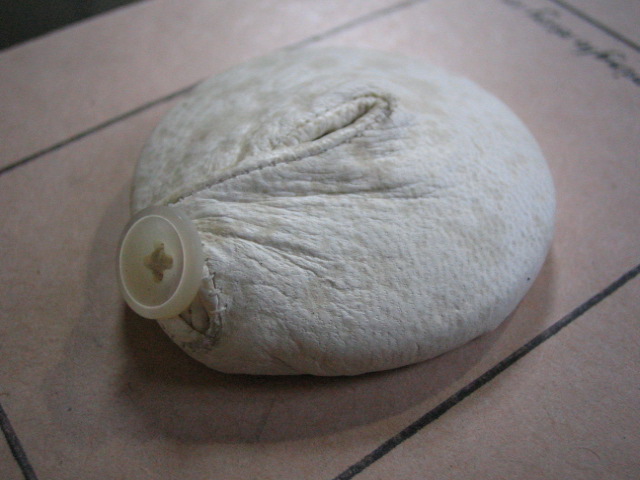
-On doing damage as an exchange,
-On flying the plane
In a couple of months I will be leading a discussion into what experts mean when they say something is wrong. When I say leading I mean as an explorer into a world of language that is usually tactile, assumed or missing. It is a wild land and there will be refreshments for the explorers.
I have included some images of buttons that I use to make, finished or in progress. They each required a leap of understanding as to button-ness as they had pins in them or were made from something unlikely or were just fiddly and full of construction jeopardy. I knew how far I could push things and this is what we will discuss and maybe much more.
Subscribe to:
Posts (Atom)
