Monday, 26 September 2016
Red Thread
Observing surgery at St. Mary's, a hospital in central London it felt as though I was going down a dodgy back alley to get there. Feeling tired and nauseous from the extremely early start, I am not an early riser by any stretch of the imagination.
It was a labyrinth. Blank windowless tall walls, the backs of buildings but I get there. I watch as others enter this strange building with its coffee shop and shiny floors like a cross between a shopping mall and a train station. People arrive clutching A4 sheets of instructions and are redirected around the maze. Then it's my turn to enter and I go straight to the heart of it.
Blues, all in blue cotton clothing and hair nets.
I look at scans of people's internal structure and watch the beautiful undulations of contours, the waxing and waning as the mouse moves over the image. Light patches and black voids, these are read like words.Decisions,complex choices and frustrations with technology.
Suddenly we are ready and we go straight into theatre. Gore.They cut through the thick white cocoon of dressing ,dead flesh and live blood, two stitches.
I am impressed by the scrub nurses' system and shall never look at hanging 'shoe tidys' in the same way. They seem to use the VAK system and it appeals to my sense of order.
Another cocoon,it reminds me of when I bought some bumble bees and they arrived sleepy and wadded up for protection.Bursts of compassion through the routine like the blood bursting through,alive. I see the battle between the caring and the struggle with the system. I see emotional lightning as they carry each other,get each other through.
Surgeons are frustrated when they can't work, like me.
Next a five hour replumbing. Complex, orderly, and intense. I can only see so much of the stitching but the room and it's workings are a dance of people with purpose. We wear radiation protection and the surgeons look like medieval knights going to do battle.
White light, sea green paper, sky blue scrubs, orange stents and red thread. It ties the clean swabs together and is methodically counted and collected.
I leave after ten and a half hours and the outside world seems ridiculous.
Thursday, 1 September 2016
Needlelace
Vascular surgery is founded on some lacemaking techniques and so it seemed obvious that I should be showing a senior vascular surgeon how to do a single brussels stitch. The focus was on the importance of tension of thread and spacing of stitches in the cordonnet. With this stitch you also need to go backwards with every alternate row. Unlike knitting where you turn the work over and always work from left to right (if right handed) with needlelace you have to turn the stitch. This is where all my insistence of using the less dominant hand and thinking about things differently comes into play.
I had focused on embroidery stitches which have similar hand movements or techniques so that the muscle memory was there to cope with the mental rigour of the exacting repetition of lacemaking. There is little room for mistakes with needlelace as it is not always easy to unpick and the thread must not run out mid row .You must be thinking ahead to observe the condition of the thread and all thread ends must be hidden away and evenly hidden away at that !
The twisting of the thread must be kept in mind and it was the revelation to some surgeons that a quarter turn to the needle every few stitches keeps the thread from buckling or twisting which began this project. Most embroiderers can just let the needle spin out when it becomes too twisted to work with but when that is not possible you turn the needle 'back'. This is also useful when you have a patient! but it is not taught as standard. This is referred to by Prof. Kneebone as 'reciprocal illumination' and is the gold of this project that we are looking for.
Wednesday, 31 August 2016
Plaits
Before the first lacemaking group began we talked about exercising and warming up the hands before work. I knew from the previous 'thread management ' and 'craft of surgery 'meetings that puppeteers warm up their hands and fingers before working but did the surgeons? I had been thinking about what it was that I did and realised that of course every day I worked my fingers by plaiting my hair.
It takes me ten minutes every morning to brush out and then re-plait which is a really complex task if you watch it being done. The control of loose strands, the small twist to each section with every move to make sure they are tight and smooth and the management of the lower un-plaited strands only covers the basics! If you do two plaits you begin one with the right hand dominant and the other with the left hand dominant. Each plait begins as a 'reflection'of the other with one hand dominating the tension and then as you work down the plait your hands are working in tandem.
The complexity of movement is not something that we give much thought to but I have observed that a lot of textile artists have plaits ! and that we say 'do' rather than 'make' a plait (rather like the zen gardeners just 'do' instead of think when they rake the gravel in straight lines).
Friday, 26 August 2016
Still life and surgery
Another drawing session this time with a still life group to draw. This combined a hand carved wooden curve, a pear and two glass vase 'frogs' so we had hard lines, soft curves and refracted light to tackle. We were looking at how to attempt all of these with just pencil marks and a rubber plus how to think through the problems they presented.
The glass became the challenge as it was confusing and changeable to look at so I went through some ways of looking at the light and the structure it was shining through by using a layered surface approach with mark making (scribble/shade/rub out/add detail). It was certainly something that you have to demonstrate not describe!!!! Sometimes just dragging the rubber(eraser) through the drawing with a rapid directional movement suddenly gave it 'light'.
It was all about looking and really seeing ( of course !!) Do you see the cut surfaces or the curves, the light or the shade in the carved parts.Where does a pear sit when it is not on a flat surface?
Then I suggested that everyone drew left handed (all right handers) and it worked really well. In fact the drawings were more relaxed and expressive because with a small loss of control it meant that no-one was fighting their pre-conceived ideas of wood/pear/glass.
Sunday, 21 August 2016
Thoughts
So far two things have occurred to me whilst working on this project. Sometimes there may be an idea floating in your head and it is only when someone else brings up the same subject that you find that you want to do something about it !! I always think of these moments of serendipity as markers. They show you the way on the path to your next work.
The first thing is my trying to unravel the idea of reflected movement, going backwards, left versus right bias and twist. A student asked me if it mattered with a french knot which way around the needle you wrapped the thread........I said yes and no and yes. I then needed to talk to a friend who is an anarchist knitter and she said it mattered when you knitted a raglan sleeve with the decreasing and that you can't crochet with string very well. She then had a dream about it and so we may move towards some writing on the matter !!
The other thing was whilst watching one student make an indescribable mistake on a piece of needlelace (more on that session in another post), I found myself thinking about how I could incorporate that mistake into a new technique !!
Thursday, 18 August 2016
Stitching
For a couple of our stitching gatherings we have been looking at embroidery stitches, some flat some raised. I wanted to lead students who may have no experience of needle and thread through various techniques which related to each other and ultimately to needlelace.
Firstly everybody did a plain running stitch. I gave them the history of how in centuries past this was a vital stitch for all women as it gave them the means to make all their family's clothes.For many it meant they were marriageable!!!! I wanted to look at needle handling with everyone first before we moved on. That done I demonstrated how to make the stitches smaller and closer together so that they could be used for seaming. Those that were already experienced had to do theirs with the less dominant hand!!Rhythm is an important factor in stitching and I wanted to try and establish this from the beginning too.
From here we went onto chain stitch so that we could look at the loop through required to make the chain work. This directly relates to buttonhole stitch and so ultimately to lace making so it was important to get the feel and the rhythm of this right.
Over two days of embroidery the students (medical students and surgeons) practised right and left handed embroidery, stitching in circles and a range of raised embroidery stitches. We finished with putting them all together in a small design so practising not just the individual stitches but also how to plan a complex design and how to literally place raised stitches close together without catching the others as you go.
One aim was to look at managing your thread rather than just focusing on where the needle is.A twisted thread can really hinder your work and it is so easily avoided by simply turning the needle counterclockwise every few stitches. It is not always possible to just let the needle hang from the work and unwind itself and it is good practise to keep an eye on the thread condition too.
My other aim is to examine how useful it is to be able to use your less dominant hand to stitch with. This will be a recurring theme in these sessions as there are occasions where your dominant hand is either shadowing the work or it is just easier to get into a small space with the other hand.
Saturday, 6 August 2016
Yarning
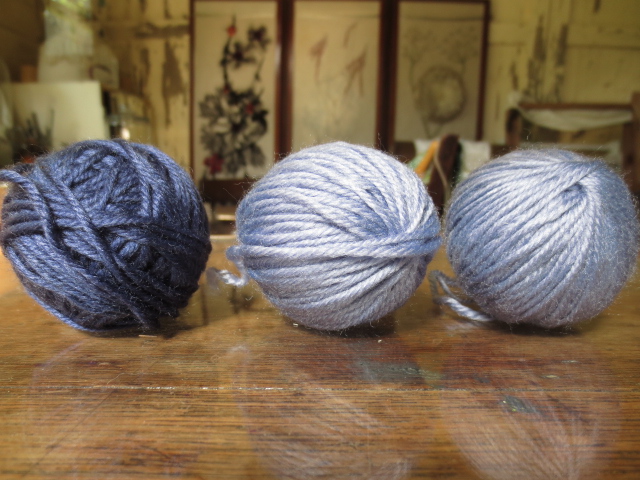
The first sessions with surgeons and surgical students have been focusing on basic drawing and embroidery skills. To ease us into the day we have begun with two exercises, drawing and yarn balling. This post will focus on the yarning!!
To take yarn and roll it into a ball seems easy enough but if you watch yourself do it and then try and describe it to someone else it becomes very complicated! The joy of our hand -eye-brain coordination which we take for granted. (For the purpose of understanding I refer to the hand you use most often as the dominant hand, DH, as left and right handedness is a subject for discussion in itself.)
With your DH you wind rhythmically and with even tension observing all the time the wrapping around to create the ball. It is the other hand that is doing all the work ! The thumb is working in counter tension with the little and ring finger to rotate the ball, whilst also acting as a thread guide. Your index and middle fingers drive the motion of the ball with a small turn so that the yarn spirals. ..and you don't even think about it. Starting off is the most tricky and I taught a very neat 'figure of eight and fold over' method but some prefer to make a sausage of yarn and then fold that with the less dominant hand to create the centre. Surgeons are quite good at this !
This simple exercise give us time to discuss tension and rhythm and how the twist is vital not only to creating yarn but also controlling it. Rhythm is vital to 'getting the knack' of something when learning new skills and tension is what makes stitch work properly. It was also noted how meditative this was.
We talk about the idea that 'if it looks good then it is good'. To put it very basically if a stitch is correct and looks neat then it will work whether it be for embroidery or for surgery. Neatness is not just about being pretty it has a necessary working function.
Some of these ideas relate back to the drawing as we are creating a sphere from a line just like drawing an apple. Rhythm is just as important in drawing as is weight of line and tension of line.
Subscribe to:
Posts (Atom)