Friday, 14 April 2017
Femoral Bypass
This was a seven hour operation and nobody gets a break.Sometimes the surgeons get to sit. I stood and watched and these are my thoughts.
A vein harvesting is like unpicking very fine fabric, you can't damage any of the surrounding material but it is securely and stubbornly attached to it.
Over a hundred sutures needles are used; the endless counting and opening of sterile packets .All packaging is opened by a theatre nurse in a peel apart movement and then offered to the scrub nurse without handling the contents.
Bead sutures have big beads on the end.
7-0 needles are very tiny, like thorns.
This procedure requires six surgeons working all at once.
The vein is passed through a metal tube which has been inserted under the flesh, it has been measured to make sure it is long enough and has been checked for twists. It has had a catheter passed along it to check that there are no obstructions.The surgeon noted any resistance he felt as threaded the catheter through. It is like threading elastic through a waistband or threading a rouleaux loop into trapunto quilting, it is all about the resistance, the pull and the timing.
Surgeons use glue.
Monday, 10 April 2017
Finger Tips
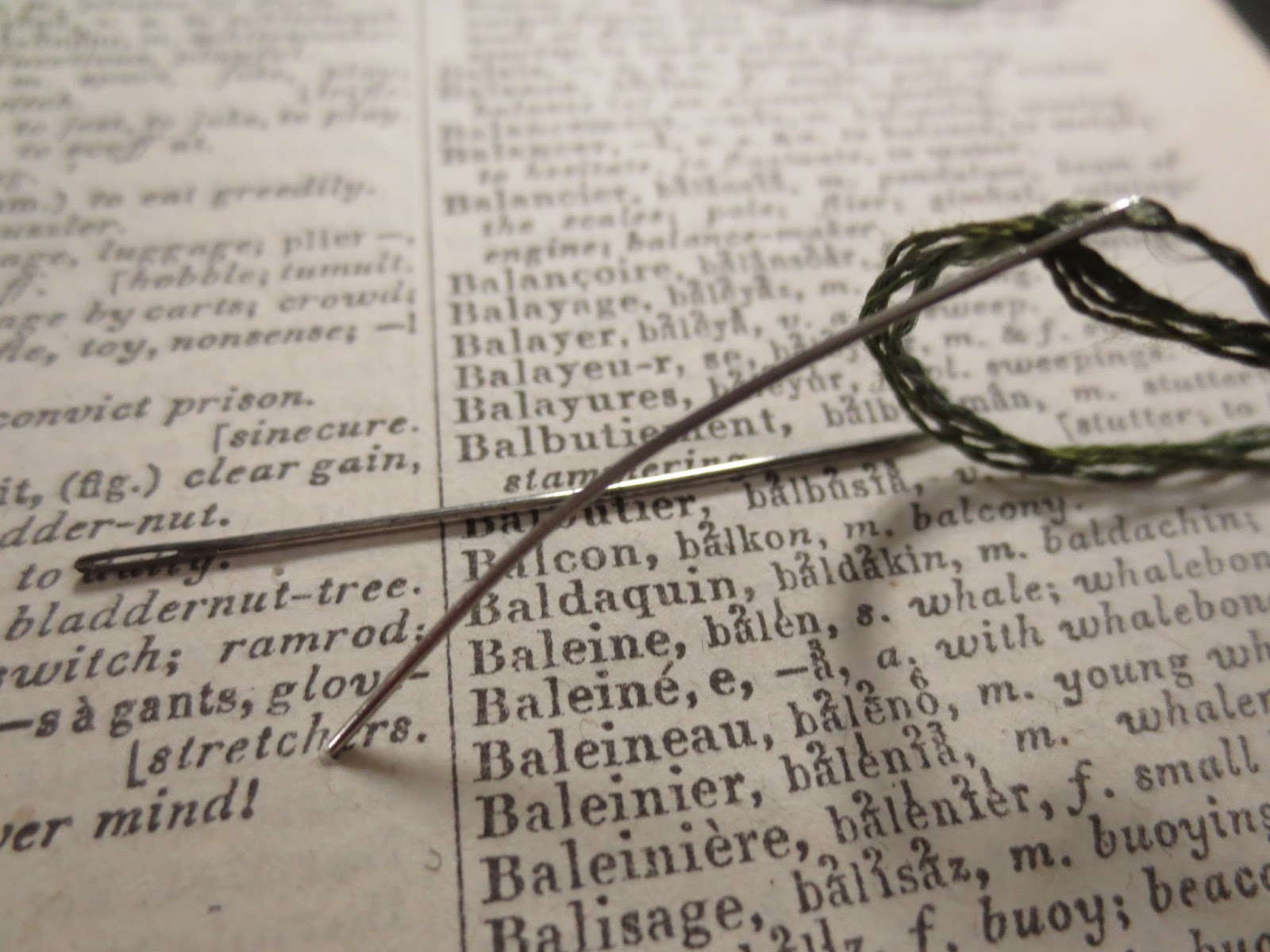
The image above perfectly illustrates how I use my fingers when making needlelace but it does not tell you what I can feel with them. Often I know where the thread is rather than feel where it is. The pressure I use to guide both needle and thread is so habitual that it can not be described.It has been written into me.
This is a riddle that you have to unravel when you teach someone how to do anything.You show them, you guide them and then sympathise when things go wrong.Some learning can only be found during touch.Some teaching can only be done once someone has learnt.Some teaching conversations are just comparisons of experience. '' well you know when you do that thing and it felt like that, well this is a bit like it''.
The use of tools is something uncommon amongst the creatures of this world and we humans specialise in it.We don't always know just how good we are at it until we teach or talk to others in different fields.
I spoke recently with Mr.Donald Sammut a consultant hand surgeon about what it is to be an expert. Mr.Sammut was drawing long before he was a surgeon and his work as an artist crosses over into that work with his informative illustrations of hand anatomy. We spoke about the importance of empathy in our work and how it is a mistake not to prepare properly beforehand.For Donald this means getting to know the patient and then making sure all decisions are informed ones. I must know about my work before I make it even if it is something I have never made before.Then comes technical preparation which comes from long experience.After that it is possible that you will not know what there is to find until you begin, both as an artist and a surgeon .You rely then on your expertise.
Interestingly I was told that it is your fingernail that gives your brain the information about pressure. It gives the pulp in your fingertips a sounding board and without it there would be only wobble !
Thursday, 16 February 2017
Articles
Two articles have been published this year already about this project.
The first is in The Lancet and focuses entirely on this project.
The second is in Nature and looks at the wider project base of Roger Kneebone's work with Imperial College London and the Royal College of Music, both articles are written by him.
Monday, 30 January 2017
Alterations
Imagine that you have a beautifully embroidered dress with beading amongst the embroidery.The fabric is fine and the dress is lined (the lining always being a little shorter). Then you rip the hem and the fabric is too damaged to repair.For the most part the dress is still sound so you can just shorten it.There is, of course, no 'just' about it.
Here is a checklist of things to remember:
1. What length do you want the hem to finally be?
2.How much hem allowance do you need?
3.Where are you going to cut the embroidery to minimise damage to the design?
4.Where will you cut the embroidery to minimise damage to the stitches?
5.How will you manage the beading when you cut through the continuous thread?
6.Remember the lining must be shortened.
7.You must allow for the hem allowance before you cut.
and will there be a sense of loss at the change? will it be the same dress?
I watched a lower leg being removed and the list of concerns when shortening a person are also complex.The initial cut has to be carefully considered and then made with precision.After this there are parts to be secured, saved and fastened.The damage and excess are removed and the hem turned up.Some gentle manipulation to make sure that the delicate material hangs correctly and the work is done.
Monday, 14 November 2016
In a jar, part two
After my visit to the Gordon Museum I went to the Hunterian museum on Lincolns Inn Fields. This is a public museum but still not to be taken lightly. As I mentioned in the previous post I knew that I would find this difficult .
I had come to see the Evelyn anatomical tables.These are seventeenth century wooden boards with the veins,nerves and arteries of a body laid out on each like a strange piece of lace.So delicate and so unnerving, you are looking at the wiring of a human who walked and talked set against a dark wooden board with knot holes looking out at you from between the vessels.The rest of the body had been dissected away from them rather like cutting away the fabric from the seams of clothes instead of unpicking them.
Much of the museum consists of displays of wax topped glass specimen jars with beautiful hand written labels and it was these that moved me most. I found that I was mourning the puss moth in a jar and thinking of the hyacinth flower that never was, floating like a strange jelly fish with its' long white roots.I kept asking myself if it was necessary to truncate so much life in order to study it but answered straight away that it must have been.
Knowledge is made up of tiny stitches, like Charlotte Waite's cross-stitch celebrating her survival of chloroform. And like the film I watched three times upstairs of a coronary bypass. And the latex skin pads for students to practise suturing which resemble trapunto quilting. Fragments of knowledge made from lives and sewn together.
The next day I sat in my studio and sobbed.
Monday, 7 November 2016
In a jar, part one.
I was given the opportunity the other day to visit the Gordon Museum in London. This is a large pathology museum not open to the public but as artist in residence at Imperial college I was allowed.
For a sensitive soul whose emotional field often extends over to others this was not something I undertook lightly. In fact I was on emotional lock down so that I could process what I was to see. A pathology museum is no freak show, all is regulated and specimens are all displayed anonymously in glass vitrines.It is however a museum of pain where everything you see is an example of disease in every organ of the body.
I had come to look at the vascular corrosive casts. This technique is similar to the lost wax process in silversmithing whereby something very delicate can be cast without damage, in this case blood vessels.On their own arteries and veins resemble ferny seaweed floating in a jar of water.
It was difficult however to walk past faces and hands in jars and not think of the lives attached.So many people have given their bodies to science and it was very moving. At times I had to dive into the nextdoor Life Sciences museum for a break!
Here was a beautiful little natural history museum with wooden cabinets and birds nests and bones. You can look at a row of skulls showing the evolution of man and blithely consider millions of years of time sitting on a shelf in front of you.
What lies between the two museums is a corridor where a piece of medical 'folk art' lives. Wood carvings done by bored medical students as they waited on call in a maternity unit, some of them explicit, all celebrating new life. It was a between world.
There was so much to consider it was dizzying and also an emotional slalom. There was a strange removal of emotion about it all and yet I kept wondering who here was unloved and who beloved.
Monday, 24 October 2016
Angiograms
![]() |
| aortic stent graft |
Rather like a Christmas decoration that once unfolded you can never get back in the box, this type of stent is a hand stitched metal mesh onto gortex which is expanded once inside the body.The procedure is done by watching the x-ray on screen .Not only can you see it expand but you see the shifting shadows of the bones and tissue around and behind it which is what I found beautiful.
The sharpness of the metal and its gold marker points against the stormcloud softness started me thinking about how to do a lace version.I would have to bend some techniques to do this but it would be just like when I teach drawing.There would be no difference between learning how to use the flat of the pencil to shade and then the sharp point to pull out details. Lots of 6B and 2B I reckon, just in thread!
image found here
image found here
Subscribe to:
Posts (Atom)